 |
|
Dear Friends,
In 2026, there is no shortage of bad news that can ruin our day. We wake up, doom scroll for five minutes, and are ready to throw our phone across the room and just go back to bed. We often feel helpless to stop the suffering of so many around the world and are conflicted about where to dedicate our energy and time.
I experienced this feeling again last week when reading about the water crisis in Puerto Rico, where more than 500,000 people don’t have access to clean, running water. I know I’m mostly preaching to the choir, but it is infuriating to know we live in a world with so many billionaires, while so many people lack access to something as basic as clean water. Again I found myself asking, “what can I do?”
This is personal for me with my wife being Puerto Rican and having rescued multiple dogs from the island. The strong and resilient people of Puerto Rico have been through so much and again are facing the devastating combination of the effects of climate change and a government that cares more about profit than human rights.
Here’s a little background:
The current water crisis is part of a broader struggle to protect Puerto Rico’s natural resources. Yes, there is a historic drought made worse by climate change, but for months, people on the island have been denouncing Proyecto Esencia, a proposed luxury tourism and residential complex in Cabo Rojo, Puerto Rico. The complex spans approximately 2,000 acres and three miles of beachfront, and includes hotels, exclusive residences, golf courses, a private airfield and is backed by billionaire foreign investors.
While there has been a lack of capacity to supply water to the project, some politicians continue to do whatever they can to allow these kinds of commercial developments, including loosening restrictions that protect the island’s unique geological environment. Of particular importance in this protected landscape is the island’s karst aquifer, a natural filtration system created through tiny fissures and fractures in limestone formations. The karst acts like a sponge that gathers and supplies fresh water to 500,000 Puerto Ricans.
Senate Bill 1183 and Senate Bill 1173 could seriously harm water quality in Puerto Rico by weakening or eliminating the prior environmental controls in order to encourage more construction. These measures help enable projects like Esencia, which could destroy significant areas of wetlands and dry forest.
Residents of San Juan and other affected municipalities, under the banner of the “We Demand Water” coalition, along with progressive and feminist organizations, are demanding real solutions to the water crisis. They have held strikes and protests aimed at politicians who back this type of development.
So, what can we do? The obvious answer is to continue our work combating the climate change crisis and ensuring our environment, health, and communities are not being sacrificed for corporate benefit. Whether it is submitting testimony, showing up at a rally, educating yourself or others, donating to an organization, or simply using a reusable water bottle instead of buying bottled water, it all matters. Never doubt the impact of your actions, regardless of how small you may think they are. If you would like to help Puerto Rico specifically, here are some ways. As always, thank you for your passion and support.
|
 |
|
A Note from Samantha Marte:
After five rewarding years at Oregon PSR, this month I am stepping down as Healthy Climate Program Director. As my first professional role after college, this chapter has been an invaluable journey of growth and learning. I am deeply grateful for all the knowledge I have gained and the coalition accomplishments I helped win alongside each of you. It has been such an honor to testify, write, organize, yell, chant, sing, present, and table alongside this team of stellar advocates. Fortunately, I won’t be far. I will be joining the Coalition of Communities of Color as Advocacy Manager, and I anticipate that my path will continue to cross with you all in the fight to achieve climate justice.
Please spread the word about the search for our new Healthy Climate Program Director.
Best,
Samantha
|
|
[Ed. note: To read Executive Director Vin Intondi's statement on Samantha's departure, make sure to check out last month's newsletter.]
|
|
Much like in the situation in Puerto Rico discussed earlier, where community health and environmental protections are being sidestepped for the sake of industry and financial interests, we are seeing community health similarly deprioritized for the benefit of the nuclear industry.
This year has brought a wave of proposed and implemented policy and rule changes designed to deregulate the industry and accelerate nuclear energy development, including several just this month.
|
|
|
|
One proposed rule would significantly limit the scope of environmental review under the National Environmental Policy Act (NEPA), allowing some impacts of nuclear development to receive less scrutiny or be excluded from review altogether. OPSR joined with partners across the country in submitting comments opposing these changes and the weakening of important environmental protections.
A separate proposed rule would eliminate the longstanding requirement that radiation exposure be kept “as low as reasonably achievable” (ALARA), removing an important safeguard that requires the nuclear industry to take reasonable precautions to limit unnecessary radiation exposure to workers and the public. Because radiation can cause harm even below existing regulatory limits, eliminating ALARA would weaken protections while shifting more of the risk from industry onto communities. TODAY, August 31, is the final day to submit a public comment opposing this change. Visit Protect Better, a project sponsored by Physicians for Social Responsibility and community partners, to learn more and find links to submit your comment.
|
|
|
|
Data Center Moratorium Rally + Lobby Day
📅September 8th
⏰9 am-5 pm (Rally is at 12:30pm on the North Side Capitol steps and open to all) 8:30 to 9 am gathering time is for people who have RSVP’d for the lobby day by Wednesday September 2nd
📍 Oregon State Capitol, 900 Court St. NE Salem OR 97301
🔗RSVP for Lobby Day HERE by Sept. 2
❤️WEAR RED!
|
|
|
Join us in Salem on September 8 to tell our elected officials that Oregonians are demanding a statewide three-year moratorium on data centers!
The rapid buildout of data centers is putting enormous pressure on our water resources and electricity grid, threatening our climate goals, and impacting farmland and communities across the state. We need legislators to act now to make sure the problem doesn’t get worse.
The day will include meetings with legislators, a rally, and opportunities to attend House and Senate Energy & Environment committee informational hearings. Wear red! Public pressure is one of the most powerful ways we can push legislators to take action, and showing up together will demonstrate that we are united in demanding a data center moratorium.
Please RSVP in advance so we can schedule meetings with your legislators when possible. We’ll send a full agenda and more information to everyone who RSVPs closer to the day.
|
|
When working on the issues we take on at Oregon PSR, we are often on the opposing side of some extremely well-financed and well-connected interests and lobbies. That means we have to find ways to punch above our weight and maximize what we are able to achieve. To do that, we have to utilize a diversity of tactics and approaches. While we work to promote legislation we support, meet with officials, and research and work with volunteers on statements and testimony, it is also vital for us to spread information to as large an audience as we can.
|
|
|
|
|
|
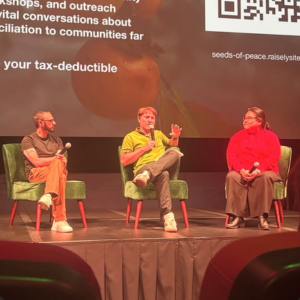
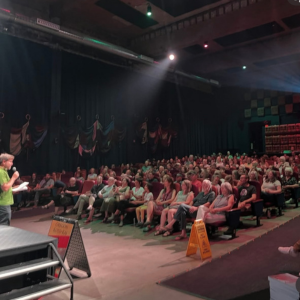
One of our favorite ways to do this is getting out into the community to connect with supporters and potential supporters face-to-face. We share information and talk about the issues that matter to us all. Here’s a look at some of the places we’ve gotten to see you over the past several weeks. Shown above are two images from the Oregon PSR sponsored screening of Seeds of Peace at the Tomorrow Theater. Vin was part of the post-film panel along with Hanako Wakatsuki-Chong, executive director of the Japanese American Museum of Oregon, and director David-Paul Hedberg.
|
|
|
The Seeds of Peace screening was originally to take place following the annual Hiroshima and Nagasaki Remembrance event in Portland. While the event itself was unable to take place due to a combination of high temperatures and poor air quality caused by wildfires, Oregon PSR was still able to participate in a variety of local events commemorating that tragic day. Shown are images of Vin speaking at events in Corvallis and Poulsbo, Washington that remembered the tragedies of 81 years ago.
|
|
|
|
|
|
Beyond those events, Oregon PSR has been busy getting out into the community in a variety of other ways over the past several weeks. Shown here are a few examples of how we get creative with our outreach and connect with people in the community. The photos include Oregon PSR volunteer Amanda Beckett tabling at Sunday Parkways in St. Johns, PSR National Executive Director Brian Campbell speaking at a recent gathering where he and Vin were keynote speakers, and Vin in conversation with Linda Pentz Gunter, author of No to Nuclear.
|
|
|
Do you know of an event you think Oregon PSR should know about or participate in? Let us know!
Here are some places where you will be able to meet with us in the weeks ahead!
|
|
|
✌️Vancouver's 23rd Annual Peace and Justice Fair & Concert
📅September 12, 2026
⏰9am to 3pm
📍Esther Short Park (8th and Columbia, Vancouver, WA)
Come say hello to Oregon PSR at the Vancouver Peace and Justice Fair!
The Vancouver Peace and Justice Fair builds community among the grassroots peace and justice groups in SW Washington and Northern Oregon. It highlights the common goals of peace and justice at home, our community, and the world. The fair helps each of us find further ways of dedicating our lives to peace and justice.
|
|
|
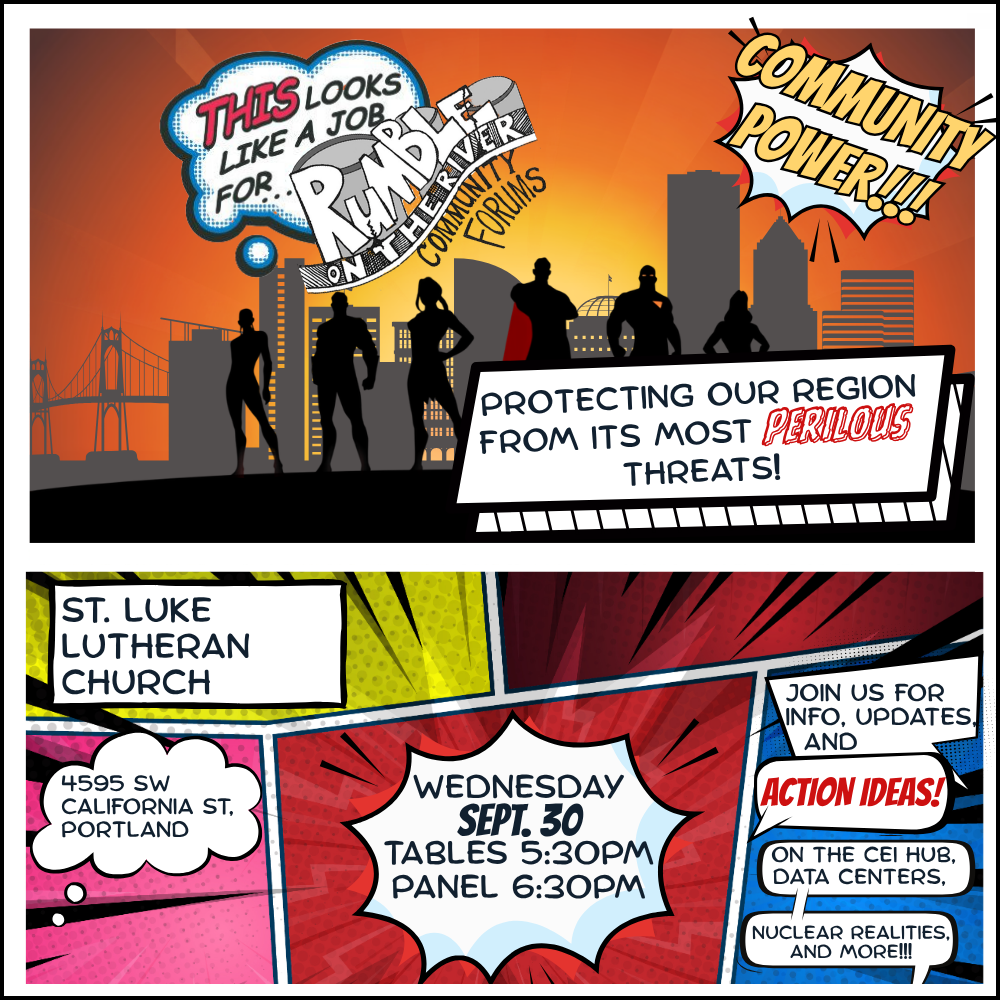
Rumble on the River Community Forums #33
🛡️Protecting Our Region From Its Most Perilous Threats
📅Wednesday September 30
⏰
🚪Doors and Info Tables: 5:30 pm
🎤 Panel: 6:30 pm
📍St. Luke Lutheran Church // 4595 SW California St., Portland, OR
💲Rumbles are always free
|
|
|
|
Join us for info, updates & action ideas on the CEI Hub, Data Centers, Nuclear realities and the proposed refinery at Port Westward's Columbia River Estuary
Panel:
Audrey Leonard: Staff Attorney with Columbia Riverkeeper
Deren Ash: Campaign Manager with La Pine Data Center Accountability,
serves on Oregon Data Center Defiance Steering Committee
Jacob Roloff: Helvetia Farmer & Manager @ Roloff Farms, serves on Oregon
Data Center Defiance Steering Committee
Kelly Campbell: Policy Director with Columbia Riverkeeper
Nick Caleb: Climate and Energy Attorney with Breach Collective
|
|
|